
The Value of U.S. Global Health Investments
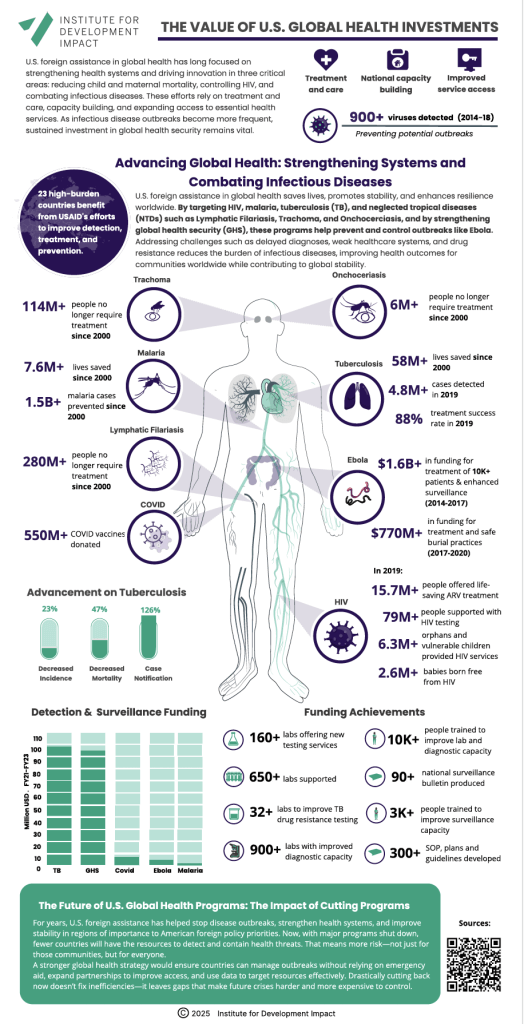
For decades, U.S. foreign assistance has played a crucial role in stopping disease outbreaks, strengthening health systems, and improving stability in regions critical to American foreign policy. However, with major programs being shut down, many countries now lack the resources to detect and contain health threats, increasing risks globally. A stronger global health strategy must ensure that countries can manage outbreaks independently, expand partnerships to improve access, and use data effectively to target resources. Cutting back on these investments doesn’t fix inefficiencies—it creates dangerous gaps that make future crises harder and more costly to control.
Sustaining the Impact of 60 Years of Advancing Women’s & Children’s Health
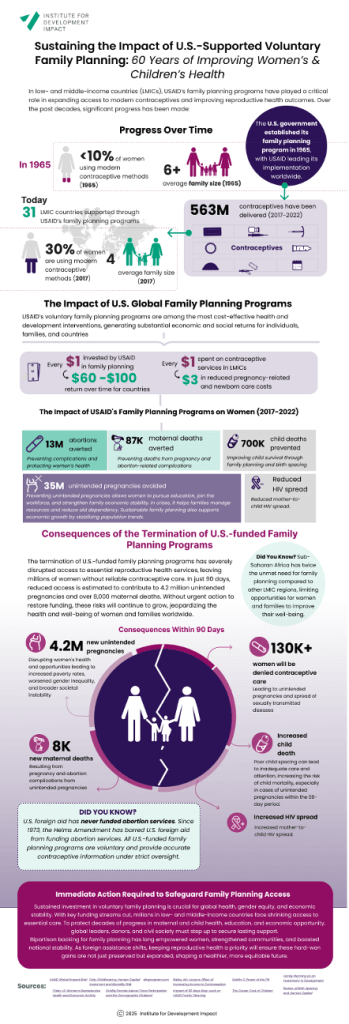
For 60 years, U.S.-supported voluntary family planning programs have transformed lives by expanding access to contraception, reducing maternal and child mortality, and driving economic stability in low- and middle-income countries. However, recent funding cuts put millions at risk, threatening decades of progress. This infographic explores the impact of family planning investments, the consequences of disrupted funding, and the urgent need for sustained global support to ensure continued access to reproductive health services.
Dismantling USAID: Consequences for Americans and Global Development

USAID isn’t just foreign aid—it’s an investment in America’s economy, security, and leadership. For example, for every $1 the U.S. invests in agricultural research projects, we get back $8.52 in economic returns. Cutting USAID puts over 200,000 American jobs at risk and could cost the U.S. $23 billion in exports, hitting farmers, businesses, and manufacturers hard.
Beyond economics, the stakes are global. Without USAID, millions will lose access to food, healthcare, and education—fueling instability that threatens U.S. security and trade. Yet, USAID’s budget is under $40B, a fraction of what we spend on defense.
At a time of global challenges, can we afford to weaken one of our most effective tools for economic growth and stability?
Environmental and Economic Impact of Food Wastage

This infographic illustrates the complex relationship between food wastage and its environmental and economic impacts across the supply chain. Through clear visuals and data, it maps out loss points from production to consumption, quantifies environmental damage, and presents practical mitigation strategies for creating sustainable food systems.
The Pathways to Living Income: A Farmer Segmentation Model

The Pathways to Living Income: A Farmer Segmentation Model takes a data-driven approach to categorize farmers based on three key factors: resources, productivity, and empowerment. By identifying specific segments within the farming community, the model enables precise interventions tailored to each group’s unique needs. Whether it’s improving resource access, boosting productivity, or empowering women in decision-making, this model guides program development to help farmers achieve a sustainable living income. Through targeted support, the framework fosters resilience and long-term economic stability for smallholder farmers.
Social and Environmental Impact of the Textile Industry

October 8th marks World Circular Textiles Day. From the water used to grow cotton, to the energy consumed in manufacturing, and the waste generated at the end of its life cycle: our fashion choices have a big social and environmental footprint. The textile and fashion industry currently operates on a predominantly linear model. This creates […]
From Research to Action (R2A) and Evidence to Action (E2A) Final Evaluation Brief

R2A & E2A Final Performance Evaluation lnfographic Summary

Performance Evaluation Report of USAID’s Ocean Plastics Portfolio to Inform the Save Our Seas Initiative
This document was produced for review by the United States Agency for International Development. It was prepared under Task Order No. 7200AA22M00005: Program for Local and Urban Sustainability, a task order under OASIS Unrestricted Contract (Pool 1) Contract No. GS00Q14OADU113 implemented by Deloitte Consulting, LLP.
Impact of Deforestation on Climate – Strategies for Reducing Greenhouse Gas Emissions

Deforestation is a major driver of greenhouse gas emissions, contributing significantly to global climate change. This infographic, part of a series focused on agriculture’s role in greenhouse gas emissions, delves into the specific impacts of land use change and deforestation. It highlights the direct and indirect emissions caused by deforestation, including carbon dioxide from tree felling and methane from anaerobic fermentation. The infographic also presents key mitigation strategies, such as reforestation, afforestation, and sustainable forest management, emphasizing their potential to significantly reduce global greenhouse gas emissions by 2050.
Primary Sources of Greenhouse Gas Emissions in Dairy and Cattle Farming

This infographic provides a visual narrative of the significant impact of dairy and cattle farming on climate change through the emission of greenhouse gases. It specifically focuses on the major sources of these emissions within the dairy and cattle industry, including enteric fermentation, manure management, and feed production. The infographic highlights key opportunities for reducing emissions, such as improving feed and nutrition, selective breeding for lower methane production, enhancing animal health, and increasing overall productivity. By illustrating these elements, the infographic aims to underscore the potential for significant greenhouse gas reductions within the dairy and cattle sector through targeted mitigation strategies.
Contribution of Agriculture to Greenhouse Gas Emissions

This infographic provides a visual narrative of how agricultural activities contribute to climate change through the emission of greenhouse gases. It specifically focuses on the primary drivers of these emissions within the agricultural sector, regional variations in greenhouse gas production, and key opportunities for reducing emissions associated with agricultural practices.