
Endline Performance Evaluation of the USAID Global Health Ebola Team (GHET) Ebola Virus Disease Survivor Program

Country

Sierra Leone, Guinea, Liberia

Region

West Africa

Type

Evaluation Report

Year

2018

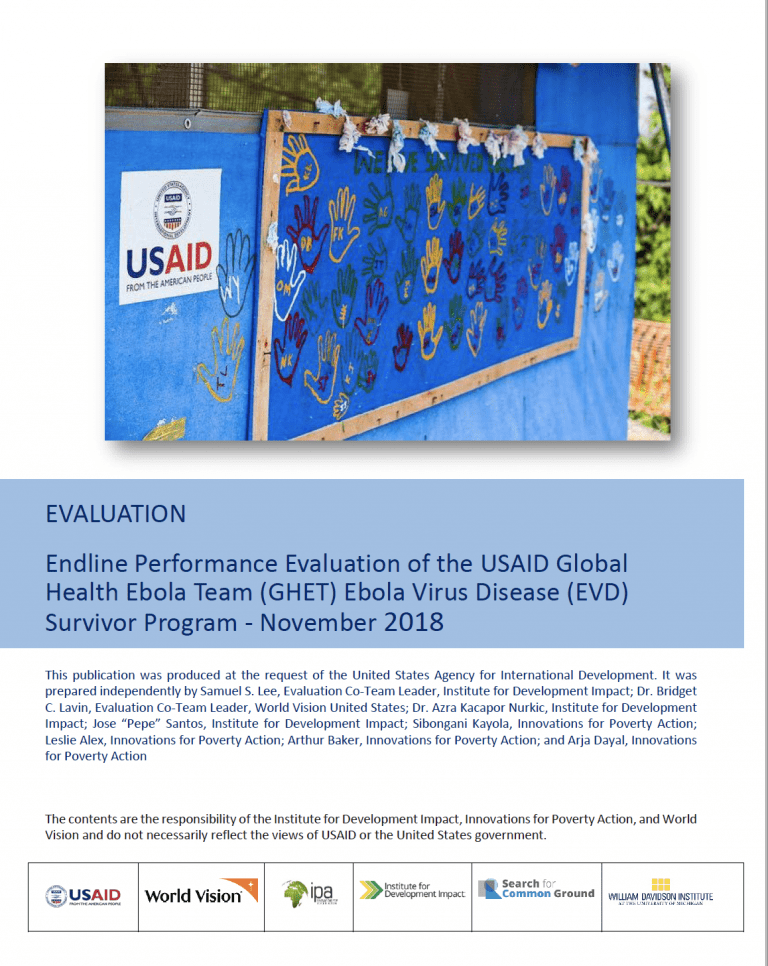
Endline Performance Evaluation of the USAID Global Health Ebola Team (GHET) Ebola Virus Disease Survivor Program

Country

Sierra Leone, Guinea, Liberia

Region

West Africa

Type

Evaluation Report

Year

2018

Abstract:

I4DI designed and implemented a final evaluation of USAID Global Health Ebola Team’s (GHET’s) Ebola Survivor activities in Guinea, Liberia, and Sierra Leone. Using a mixed-methods approach, the evaluation team drew on quantitative health facility assessments, quantitative provider surveys, qualitative key informant interviews at endline, and use of baseline and endline quantitative surveys conducted among Ebola Virus Disease (EVD) survivors by implementing partners. The GHET program was effective, particularly in reducing the stigma EVD survivors experienced from health providers in Guinea and Liberia. In Sierra Leone, provider stigma was already the lowest among countries at baseline and remained so at endline; thus, the same reduction was not evident. While the GHET EVD survivor program also improved the availability of clinical services for EVD survivors, accessibility of care was more difficult to improve at the primary level given systemic public health weaknesses in Guinea, Liberia, and Sierra Leone.

Description:

Within the GHET Pillar II portfolio, this performance evaluation was an outcome-level study to determine the endline effectiveness of the program’s survivor-specific services. The evaluation questions were focused on whether program health services addressed the needs of Ebola survivors and were integrated into the public health system in order to mitigate the effects of further Ebola infection among the population. When considering program implementation and preparation for future public health crises, the establishment of and capacity-building support to EVD survivor networks and government bodies contributed positively to the program’s efforts. However, the integration of survivor-specific services and processes into the general public health systems of Guinea, Liberia, and Sierra Leone remains a work in progress.

Related publications

Development Disrupted: Reassessing the Implications of USAID’s Restructuring Amid Global Aid Realignment

This infographic analyzes the consequences of USAID’s 2023–2024 restructuring, which led to the termination of 5,341 projects and the defunding of 2,353 implementing partners, many of whom lost 100% of their USAID support. Over 55% of recipient countries lost all funding. The analysis extends beyond the U.S. to consider concurrent budget contractions by other donor countries, indicating a systemic shift in how foreign aid is prioritized and delivered. The infographic visualizes these changes, offering insights into the scale, distribution, and potential implications of a more constrained and transactional development aid environment.
The Future of U.S. Foreign Assistance: Unlocking U.S. Business Investment

This article examines the Trump administration’s proposed restructuring of U.S. foreign assistance, which seeks to streamline agencies and align aid with investment-driven growth. The plan introduces promising steps to improve efficiency and expand opportunities for U.S. businesses abroad. However, the transition also brings important considerations, such as ensuring continued access to technical expertise, maintaining regional flexibility, and supporting financing tools that encourage investment in higher-risk markets. The piece outlines ways to maximize the benefits of these reforms while addressing potential challenges to ensure the new structure drives sustainable growth and impact.

Subscribe

Enter your mail below to receive updates from Institute for Development Impact

Wishing you a peaceful holiday season
and a prosperous New Year 2026.