
|
Listen to this article
Getting your Trinity Audio player ready...
|
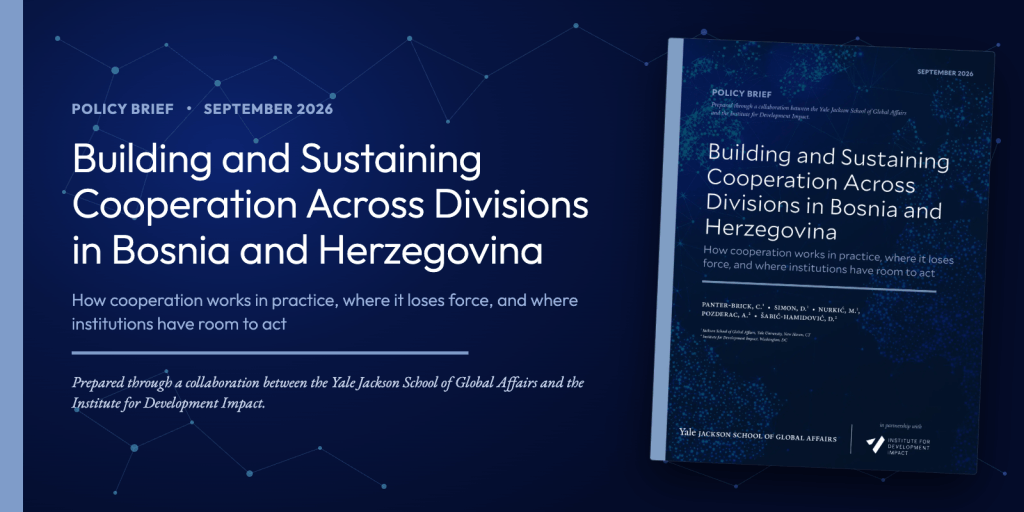
New research from the Yale Jackson School of Global Affairs and the Institute for Development Impact examines how cooperation works across political and ethnonational divisions in Bosnia and Herzegovina, where it loses force, and where institutions have room to act.
Cooperation across political and ethnonational divisions is more common in Bosnia and Herzegovina than its political institutions and public discourse often suggest. People work, trade, research, organize and solve problems with others despite divisions that remain highly salient in the country’s politics.
Our new policy paper, Building and Sustaining Cooperation Across Divisions in Bosnia and Herzegovina, examines how this cooperation works in practice. The research looks at the Armed Forces, business, academia, civil society, diaspora engagement and the EU accession process, where the authority available to those involved, the rules governing their work and the decisions required to move it forward differ considerably.
The study draws on fieldwork carried out in Bosnia and Herzegovina and the United States between June and August 2026, comprising 23 key informant interviews and 11 focus groups and roundtables. Participants included members of the Armed Forces, business leaders, academics, civil society organizations, members of the U.S.-based diaspora and European Union officials working on the Bosnia and Herzegovina accession portfolio. The research also reviewed 118 scholarly, policy and official sources.
Cooperation works differently depending on where authority sits
Cooperative arrangements were strongest when participants had a clear reason to rely on one another and sufficient authority and institutional support to carry the work forward.
The Armed Forces provide the clearest example. Personnel from different parts of the country work within a single institution, with a common mission, chain of command and professional standards. Cooperation is part of the institution’s regular functioning rather than something that must be rebuilt for each activity.
The structure is different in business, academia, civil society and diaspora engagement. Cooperation often connects people and organizations that remain institutionally separate. They may agree on a course of action and carry out substantial work together, while the next approval, funding decision or institutional commitment belongs to someone outside that relationship. This distinction helps explain why cooperation can produce results without necessarily changing the institutions around it.
Where cooperation loses force
Across the sectors examined, three points of breakdown appeared repeatedly.
- Political backing changes. Cooperation may continue among the people directly involved while support from political leadership weakens or disappears.
- The next decision lies with another institution. An initiative can reach the point where further action depends on an approval, appointment, legal change or funding decision that participating organizations do not control.
- Responsibility and institutional knowledge are lost. Work that depends on external funding or a small number of individuals becomes difficult to sustain when support ends or those individuals leave before responsibility and relationships have been transferred.
These constraints are not unique to one sector. They recur because authority in Bosnia and Herzegovina is distributed among institutions with different mandates, budgets and political constituencies. Cooperation may therefore work well within one part of a process while implementation still depends on a decision elsewhere.
Public agreement is stronger on institutional performance
The study also considers recent evidence on public attitudes toward institutions and constitutional reform. The distinction is important.
CONSENT BiH research conducted in 2026 found substantial differences among citizens on questions including territory, sovereignty, political representation and international supervision. Views were much closer on judicial independence, professional public administration, equal rights and institutional integrity.
Public agreement is therefore considerably stronger on how institutions should perform than on how political authority should be organized.
That difference has practical consequences. Changes to recruitment procedures, professional standards, documentation of decisions or administrative coordination can often be made within authority an institution already possesses. Changes to representation, territorial organization or the distribution of authority require agreement from the institutions and political actors empowered to make those decisions.
The two kinds of reform involve different political and institutional requirements.
International support reaches the same boundary
International actors have played a substantial role in supporting institutional reform and cooperation in Bosnia and Herzegovina. The research found that this support was particularly useful where institutions needed technical expertise, administrative capacity or resources to complete work already within their mandates.
Its influence was more limited when implementation depended on political agreement over authority.
The EU accession process illustrates this distinction. The Growth Plan increased the financial incentives attached to reform, but larger incentives did not remove the need for agreement among the institutions and political leaders responsible for implementation. Technical support could help prepare the work. It could not substitute for a political decision where such a decision was required.
Strengthening cooperation
The findings point to several areas where institutions and their partners can improve the prospects that cooperation produces durable results. The paper recommends:
- Using broad public support for institutional performance to create room for reform. Professional criteria, documented decisions and verifiable rules can make widely shared expectations more concrete.
- Mapping decision processes before implementation begins. This means identifying which institution holds each required decision and where the authority of participating organizations ends.
- Establishing clear handoffs between institutions. Where one institution depends on another for information, approval or action, those dependencies should be addressed before they interrupt implementation.
- Transferring responsibility and knowledge early. Programs expected to continue after external support ends need time to transfer relationships, institutional knowledge and recurring responsibilities to those who will carry them forward.
Creating a durable public counterpart for diaspora engagement. Diaspora expertise and investment are more likely to produce sustained results when there is an institution in Bosnia and Herzegovina able to receive, coordinate and use them.
Where change is possible
The research does not suggest that cooperation removes Bosnia and Herzegovina’s political disagreements. It shows more specifically where those disagreements affect institutional action.
Some changes depend on agreement over who holds authority. Others depend on how institutions exercise authority they already have. Cooperation is more likely to endure when that distinction is understood from the outset, when the institutions needed for the next decision are part of the process, and when responsibility survives beyond the people or funding that initially made the work possible.
That provides a more useful basis for thinking about cooperation in Bosnia and Herzegovina: where it already exists, what allows it to produce results, and what is required for those results to last.
The policy paper was prepared by Catherine Panter-Brick, David Simon and Mak Nurkić of the Yale Jackson School of Global Affairs, and Andrea Pozderac and Dženana Šabić-Hamidović of the Institute for Development Impact.


