|
Listen to this article
Getting your Trinity Audio player ready...
|
Research and evaluation rarely happen in a straight line. Questions evolve, instruments change, field data arrives in different formats, analysis crosses methods, and findings must ultimately become defensible reports. Yet much of that work still lives across disconnected documents, spreadsheets, survey tools, coding applications, and presentation files. By introducing Heurista, I4DI created a connected workspace to bring that work back together.
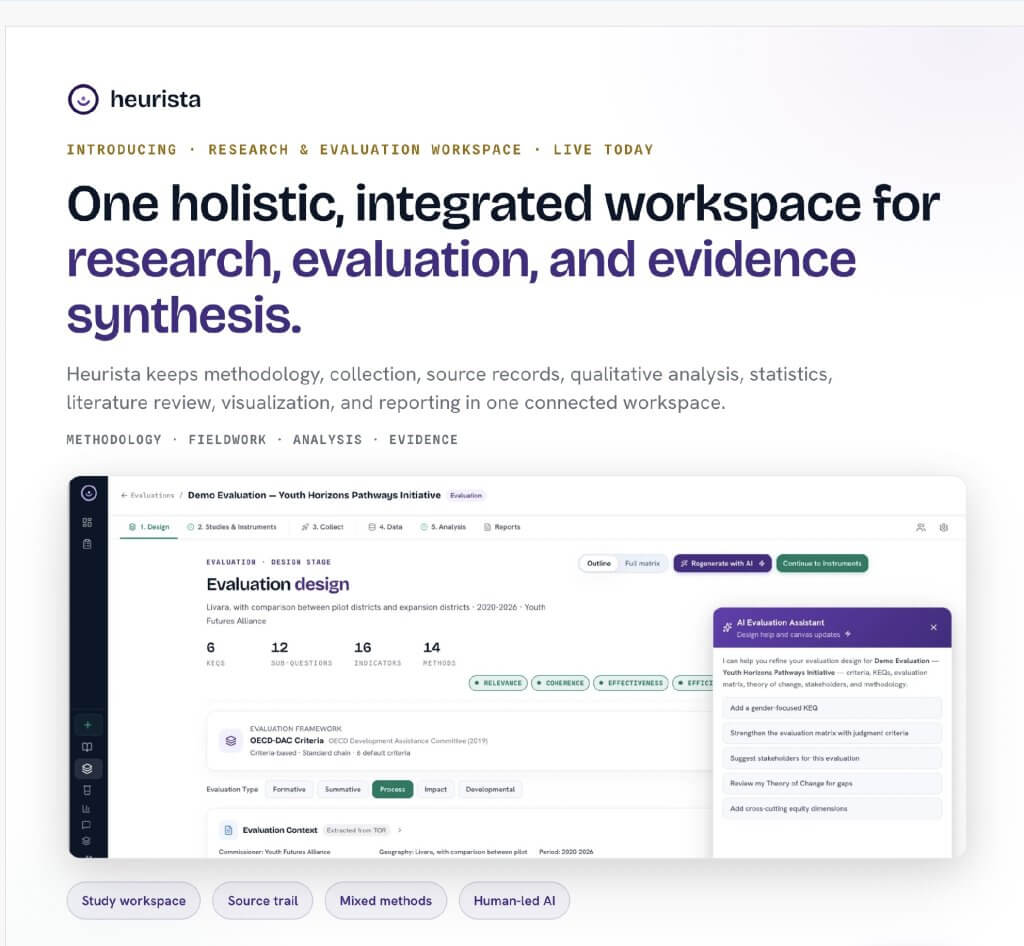
The Institute for Development Impact (I4DI) developed Heurista as a connected research and evaluation workspace for study design, data collection, qualitative and quantitative analysis, evidence synthesis, visualization, and reporting. In practice, the platform reflects a simple conviction: methods, evidence, analysis, and claims should remain connected throughout the life of a study.

Introducing Heurista as an alternative to disconnected research tools
A study can be methodologically rigorous and still lose valuable context as it moves between systems. For example, a team may shorten an evaluation question from a proposal when moving it into a spreadsheet. A field note can lose its source context. A coded excerpt may support a finding, but the connection disappears when someone copies the finding into a report draft. Each transfer creates another opportunity to lose interpretation, provenance, or analytical reasoning.
As a result, these gaps create more than administrative inconvenience. They make quality assurance harder, slow collaboration, and weaken the path between evidence and a final claim. Teams spend time reconstructing decisions rather than advancing the analysis.
One study record, from question to claim
Heurista treats the study itself as the operating structure. Questions, criteria, indicators, methods, stakeholders, instruments, sources, analyses, findings, and report sections can remain part of one connected record.
A workspace designed around research practice
Heurista does not force every project into one method. Instead, it supports evaluations, applied research, monitoring and learning studies, qualitative inquiry, quantitative analysis, mixed-methods designs, literature reviews, and evidence synthesis. At the same time, teams can shape the workspace around the study while retaining a coherent record of how they designed and carried out the work.
Design the study
Structure evaluation questions, research questions, criteria, indicators, theories of change, methods, stakeholders, instruments, and validation logic.
Collect and organize evidence
Manage forms, live collection links, multilingual material, AI-led interviews, source documents, imports, consent context, and fieldwork status.
Analyze across methods
Code transcripts, develop codebooks, write analytical memos, translate material, run statistical tools, and document findings inside the study record.
Synthesize and report
Connect literature reviews, evidence matrices, dashboards, findings, recommendations, citations, and report sections to the evidence behind them.

Introducing Heurista: human-led AI for study context
AI can reduce repetitive work, but teams should not delegate research judgment to a generic assistant. Therefore, Heurista’s AI assistant, Hue, works inside the context of the study. It can help organize information, surface methodological considerations, summarize reviewed material, and support drafting without becoming the final decision-maker.
In addition, researchers remain responsible for accepting codes, interpretations, findings, recommendations, and report claims. This distinction matters. The objective is not automated research; rather, it is better-supported research in which teams can see, review, and govern the assistance they receive.
Traceability as part of the workflow
Defensible reporting depends on moving backward from a conclusion to the evidence and analytical decisions that support it. In Heurista’s connected workspace, source records, coded excerpts, memos, statistical outputs, findings, citations, and report sections can remain linked. Consequently, review becomes a normal part of the workflow rather than a reconstruction exercise at the end.

Built from I4DI’s evaluation and technology practice
Heurista brings together I4DI’s Evidence & Intelligence and Impact Technology practices. Its design responds to recurring challenges seen across real projects: fragmented workflows, lost source context, repeated manual work, uneven review, and weak links between evidence and claims.
I4DI develops the platform under its ISO 27001-certified information security management system. Moreover, Heurista supports role-based access, workspace separation, encryption in transit and at rest, consent records, and audit trails. Heurista does not use customer research data to train AI models.
Introducing Heurista for evaluation, research, and MEL teams
Ultimately, Heurista serves evaluation teams, research organizations, MEL units, programme and portfolio teams, evidence-synthesis groups, consultants, and institutions that need a more coherent way to move from study design to defensible reporting. In particular, it helps when work crosses methods, languages, contributors, or review stages.
Introducing Heurista to your next research or evaluation project
For that reason, see how Heurista can support an evaluation, mixed-methods study, qualitative project, evidence review, or reporting workflow.